Between Eras
Kang Gong-won was born in 1901 in Pyeongtaek, a low plain that flooded whenever the rain grew heavy. He studied Confucian classics at the local hyanggyo and learned modern writing, arithmetic and music from a Japanese teacher. He grew up on the boundary where tradition and modernity overlapped.
A First Meeting
When he was fifteen, a marriage proposal arrived. The bride was said to be the third daughter of the Choi family in Anseong. Curiosity pulled him across the fields to see her.
But she already knew he was coming. A messenger sent by the matchmaker had arrived first, telling her family that “the groom from Pyeongtaek will visit today.”
So she sat on the wooden floor of the main hall, pretending to focus on her needlework— the quiet way a young woman of that era could wait.
He peeked over the fence. She looked up. He fled back to Pyeongtaek, face burning.
After they married, she only smiled when he mentioned it. Even at the end of the old dynasty, people loved in small, quiet ways.
Choosing to Stay
After marriage, he continued meeting students at the hyanggyo. Some left for Manchuria and Gando to join the independence movement.
He wanted to go. But he could not leave his young wife living under the strict hierarchy of the extended family, nor abandon his small children.
Before leaving, his friends told him:
“Help us from home.”
He understood. He would gather funds, connect people, and support them quietly— the unseen role many intellectuals carried in that era.
His Japanese teacher protected him, even issuing a statement to the police saying he was “a student devoted only to study.” Because of that, his name never surfaced.
The Journey to Gando
He traveled to Gando only once. He went to see his friends off, to confirm the route for delivering funds, and to understand how he could help from home.
His Japanese teacher accompanied him, shielding him through checkpoints and suspicion.
The harsh climate broke his health. Tuberculosis followed. He never recovered.
After liberation, none of his friends returned from China. The path they chose was a road without return.
Quiet Support
There is no written record of how he helped. But my grandmother left one sentence:
“Whenever someone came from China, another piece of land went to a tenant farmer.”
He sold land cheaply and sent the money to those heading for Manchuria and Gando. Outwardly, he looked like a kind landlord. In truth, he was a quiet lifeline.
A Man Who Listened
He disliked alcohol, but stayed with friends through the night when they visited, listening with a single untouched cup before him.
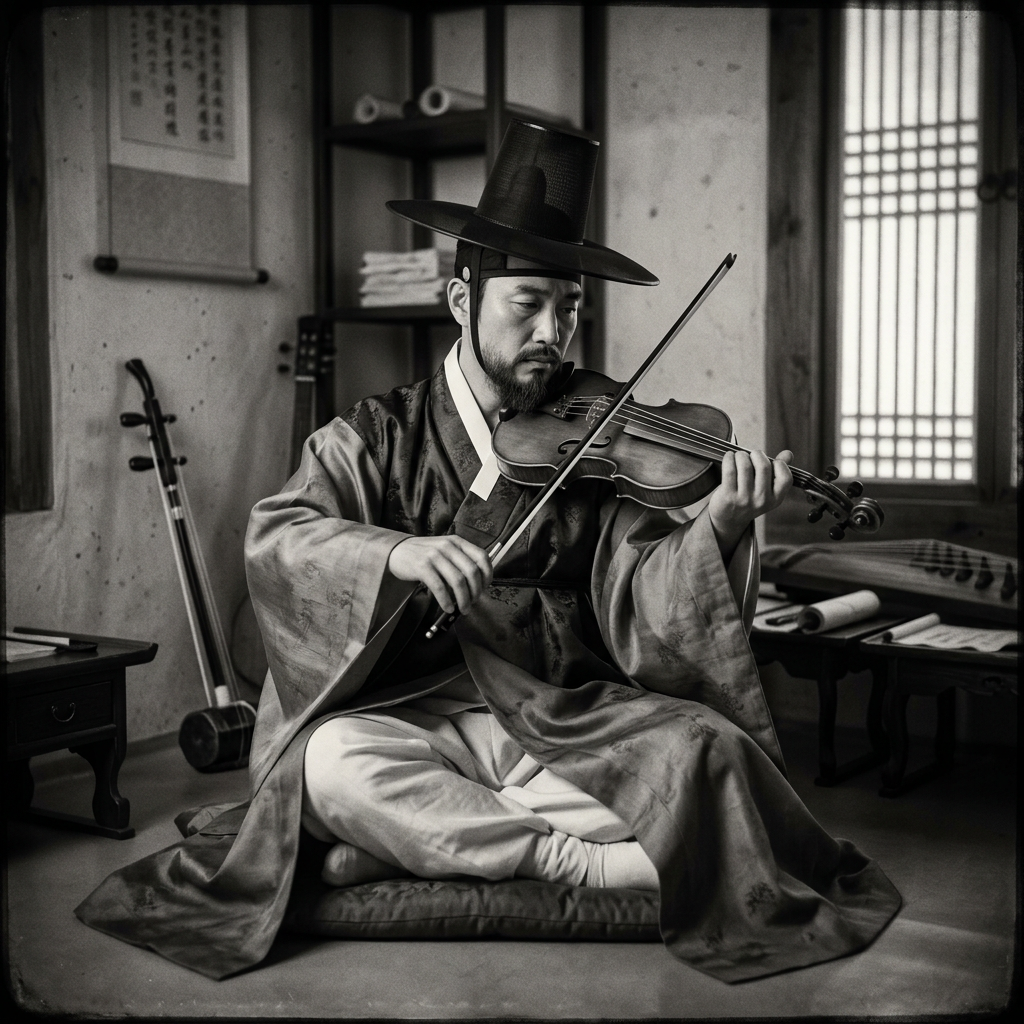
He had taken music lessons in his youth and could play both the violin and the piano. Sometimes, on those long nights, he played the violin softly while his friends talked— a small, quiet gesture of companionship.
He always looked at his wife with a soft apology as she prepared food for the guests.
The Woman Who Endured
After tuberculosis struck him down, my grandmother raised three children alone. She later said, “I had no thoughts.” It was survival pushing everything else aside.
Her days as a young bride had already been full:
- waking at 4 a.m.
- cooking three meals and two snacks for the workers
- washing their clothes
- mending their garments
- sewing thick winter work clothes
- tending fires in winter
- boiling feed for the cattle
Late at night, in a dim room, she worked the manual sewing machine. One night, the needle pierced her index finger straight through. Metal poisoning followed. The finger never bent again.
She never complained. She simply lived with it. In front of others, she covered her left hand with her right— a quiet gesture to hide the years she had endured.
Floods and Survival
When the Pyeongtaek stream flooded, their belongings floated away. Sometimes pigs drifted by, and the villagers caught them for a feast.
Even disasters were endured together. Through it all, she became a woman shaped by her era.
His Last Words
Before he died, he held her hand and said:
“It pains me that I must go without seeing our country’s liberation. I will go ahead. When you come to heaven, I will find you by your finger.”
He knew that finger— what it had endured, what it had protected.
It was not only love. It was respect.
The Unnamed
He never carried a gun. His name does not appear in documents. But he supported those who left, raised funds, avoided suspicion, protected his family, and safeguarded his village.
My grandmother, outwardly friendly with the Japanese, shielded the household and concealed his quiet work.
They were among the unnamed who protected their country in silence. And Mr. Kang Gong-won was Grandmother’s lifelong lover.
A Granddaughter’s Record
I write this as their granddaughter.
Thank you for walking through this record with me. I cherish even the quiet footsteps of those who read it as they leave.
강공원(姜公園)의 생애
두 시대의 경계에서
1901년 평택. 비만 오면 물이 차오르던 낮은 들판에서 한 소년이 태어났다. 그는 향교에서 유학을 배우고, 일본인 교사에게 근대식 글과 산술, 음악을 배웠다. 전통과 근대가 겹쳐지는 경계 위에서 자란 사람이었다.
첫 만남
열다섯 살에 혼담이 오갔다. 안성 최부자집 셋째딸이라는 말에 마음이 흔들린 그는 친구와 함께 먼 길을 걸어 안성으로 갔다.
그런데 신부가 될 소녀는 이미 그가 온다는 소식을 알고 있었다. 중매쟁이가 보낸 파발이 먼저 도착해 “평택에서 신랑이 온다”는 말을 전해주었기 때문이다.
할머니는 그 말을 듣고 대청마루에 나와 바느질을 하고 있었다. 그 시대 여성에게 허락된 가장 자연스러운 ‘기다림’의 방식이었다.
소년이 울타리 너머로 고개를 내밀었을 때, 바느질하던 소녀가 고개를 들었다. 소년은 얼굴이 화끈해져 도망치듯 평택으로 돌아갔다.
혼인 후 그 이야기를 꺼내면 아내는 씩 웃고 넘겼다. 구한말에도 사람들은 자기 방식으로 조용히 사랑했다.
남기로 한 선택
혼인 후에도 그는 향교에서 유학생들과 교류했다. 그중 몇은 만주와 간도로 떠나 독립운동을 하겠다고 결심했다.
그도 가고 싶었다. 그러나 층층시야 속에서 시집살이하는 젊은 아내와 어린 아이들을 두고 떠날 수 없었다.
떠나는 친구들은 마지막으로 말했다.
“자네는 고향에서 우리를 도와줘.”
그는 그 말의 의미를 단박에 알아들었다. 고향에서 자금을 마련하고, 사람들을 연결하고, 의심을 피하며 조용히 뒷받침하는 역할. 그 시대 지식인들이 맡았던 보이지 않는 자리였다.
그의 일본인 교사는 그가 독립군들과 교류하는 것을 알고 있었지만 모르는 척해주었다. 평택 경찰서에 “이 학생은 공부만 하는 사람”이라는 신용증명을 내주기도 했다. 그 덕분에 그의 이름은 수면 위로 떠오르지 않았다.
간도, 단 한 번의 여정
그는 평생 단 한 번 간도에 갔다. 떠나는 친구들을 마지막으로 배웅하고, 자금 전달 루트를 확인하고, 고향에서 어떤 방식으로 도울지 직접 조율하기 위한 길이었다.
그 여정에는 그를 보호해주던 일본인 교사가 동행했다. 혹독한 기후와 긴장은 그의 몸을 무너뜨렸다. 돌아온 뒤 건강은 급격히 나빠졌고 결국 결핵이라는 시대의 병이 그의 삶을 덮었다.
독립 후에도 중국에서 돌아온 사람은 하나도 없었다. 그 길은 돌아오는 길이 없는 길이었다.
조용한 조력
그가 정확히 어떤 방식으로 독립군을 도왔는지 기록은 없다. 다만 할머니의 말이 힌트를 남겼다.
“중국에서 사람이 올 때마다 땅 한 뙈기가 소작농 손으로 들어갔다.”
그 말은 곧, 그가 자신의 땅을 소작농에게 싼값에 넘기고 그 돈을 만주와 간도로 향하는 사람들에게 건넸다는 뜻이었다. 겉으로는 착한 지주처럼 보였지만 실제로는 독립군의 숨통을 잇는 조용한 자금줄이었다.
듣는 사람이었다
그는 술을 좋아하지 않았다. 그러나 친구들이 찾아오면 밤새 자리를 지켰다. 자기 앞에 놓인 술잔 하나로 친구들의 이야기를 묵묵히 들어주었다.
젊은 시절 그는 음악수업도 따로 받아 바이올린과 피아노를 칠 줄 알았다. 그래서 때로는 친구들이 이야기하는 동안 바이올린을 조용히 켜며 밤을 함께했다. 그 시대 평택에서는 보기 드문 근대적 감수성이었다.
안주상을 마련하는 아내를 미안한 마음으로 바라보던 시선. 그 시선 속에 그의 성품이 있었다.
남겨진 사람의 삶
그가 결핵으로 쓰러진 뒤, 젊은 아내는 삼남매를 데리고 살아내야 했다. “아무 생각도 없었다”는 말은 슬픔이 아니라 생존이 모든 감정을 밀어냈다는 뜻이었다.
할머니의 새댁 시절 하루는 끝이 없었다.
- 새벽 4시에 일꾼들 아침 준비
- 삼시세끼와 새참
- 일꾼들 빨래
- 옷수선
- 매해 봄에 새옷 한 벌씩 만들어주기
- 겨울엔 군불 넣기
- 소여물 끓이기
그리고 늦은 밤, 불도 밝지 않은 방에서 수동 재봉틀을 돌리다가 바늘이 검지를 관통했다. 쇠독이 올라 오래 고생했고 그 손가락은 끝내 구부러지지 않았다.
할머니는 그 손가락 때문에 불평하지 않았다. 불편해도 그냥 적응하시며 살았다. 사람들 앞에서는 왼손을 오른손으로 가려 그 손가락을 보이지 않으려 했다.
그 손가락은 젊은 날의 고단함과 시집살이의 기억을 그대로 품고 있었다.
범람과 생존
평택천이 범람하면 집안 살림이 물 위를 떠다녔다. 돼지가 꿀꿀대며 떠다니면 동네 사람들이 잡아 잔치를 벌였다. 재난 속에서도 삶을 이어가는 공동체의 방식이었다.
그 속에서 할머니는 더 이상 약한 새댁이 아니었다. 시대가 만든 강철 같은 여성이었다.
마지막 말
그가 세상을 떠나기 전, 할머니 손을 잡고 말했다.
“조국의 광복을 못 보고 가서 원통하다. 내가 먼저 가 있을 테니 당신이 천국에 오면 내가 당신 손가락을 보고 찾을게.”
그 손가락은 가난한 과부가 삼남매를 살리기 위해 밤새 재봉틀을 돌리던 삶의 흔적이었다.
그는 그 손가락을 평생 봐왔고, 그 손가락이 어떤 일을 견뎌왔는지 알고 있었고, 그 손가락이 자신과 아이들을 지켜준 증거라는 걸 알고 있었다.
그래서 마지막 순간에 그 손가락을 기억하겠다고 한 것이다.
이름 없는 사람들
그는 총을 들고 싸운 사람은 아니었다. 문서에 이름이 남지도 않았다. 그러나 그는 떠나는 사람을 뒷받침하고, 자금을 마련하고, 의심을 피하고, 가족을 지키고, 마을을 지키며 조용한 방식으로 나라를 지킨 지식인이었다.
할머니는 겉으로는 일본인들과 친하게 지내며 집안을 보호하고 남편의 활동을 가려주는 지혜로운 방패였다.
이름 없이 나라를 지킨 사람들. 그 중 한 사람이 강공원이었다. 그리고 강공원씨는 할머니의 평생 연인 이었다.
손녀의 기록
이 글은 그의 손녀가 다시 세우는 기록이다.
이 기록을 함께 지나가 주셔서 감사합니다.
조용히 읽고 가는 발걸음도 저는 소중하게 생각합니다.
