I flew from Tucson to Gatwick Airport to attend The Salvation Army’s 150th Anniversary event. The train from Gatwick into central London was quiet and comfortable. Outside the window, the outskirts passed by slowly— neatly lined English houses, calm neighborhoods, and ivy climbing up the walls of two‑story homes. Watching that scenery, I thought, “Life here isn’t so different from life in the States.” That was my first impression of London.
The city center was far more multicultural than I expected. People from every background filled the streets, and hearing a pure British accent was surprisingly rare. London felt like a massive melting pot— that was the air I first breathed in the city.
During the event, I visited Booth House in Whitechapel, the first Salvation Army homeless shelter. It was the street where early Salvationists prayed with tears more than 150 years ago. Today, the area is home to diverse immigrant communities, each shop playing its own language and music. A large mosque stood across the road, quietly showing how London has changed over time and what kind of reality the Salvation Army now works within.
I still remember riding the double‑decker bus into Regent Street. As the bus curved into the entrance of the street, 17th‑century buildings began to appear one by one. It felt like stepping into the London of another era— a place where you could imagine the city’s former grandeur. I stopped by the world’s oldest toy store, looked around at the distinctly British toys, and quietly stepped back out into the street.
The event was held at the O2 Arena by the Thames. Every morning I crossed the river from my lodging and took the Underground to the venue. That daily walk over the Thames was one of the calmest moments in London. It was July—London’s hottest days of the year— and the heat was exhausting. But at night, a brief rain would fall, cooling the asphalt and softening the air. That coolness eased the fatigue of the day.
After the event, we moved our lodging to a place near the Eurostar station. On the way, the British Library and the St. Pancras Renaissance Hotel came into view— both massive, imposing structures that felt like entire eras standing in stone.
While walking nearby, I stumbled upon a church with unusual columns. It looked almost Eastern Orthodox at first glance. When I walked closer, I found a plaque explaining that the columns were inspired by those from an ancient Greek temple. It was St Pancras New Church— a moment of Greece appearing in the middle of London.
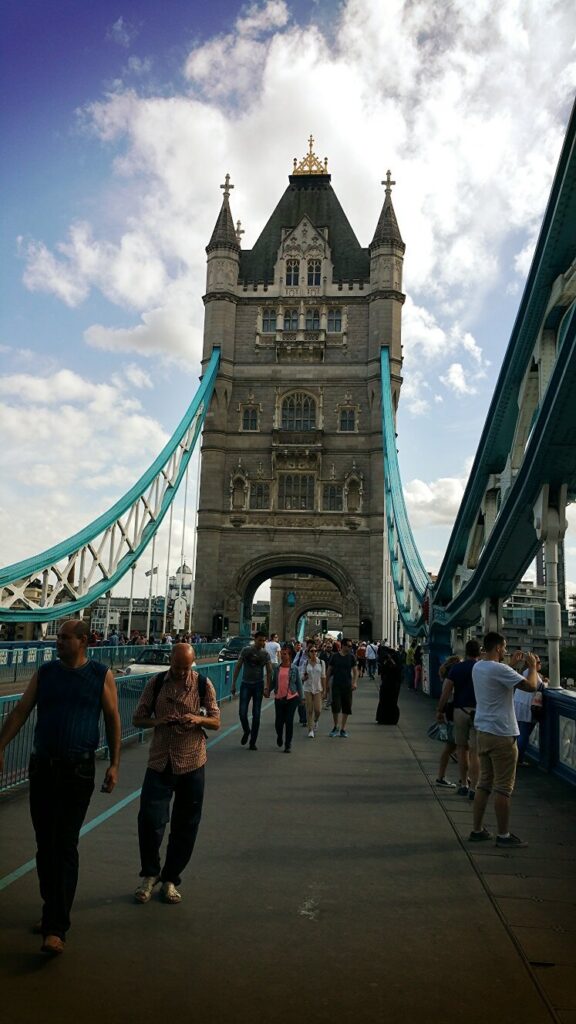
I also remember looking at the Tower of London from Tower Bridge. Today it’s crowded with tourists, but once it was a place where prisoners were held and executed. Thinking about that history made the scene feel a little bittersweet. Walking through the city, I realized London isn’t just an old city— it’s a place where many eras overlap.
Across different parts of London, I occasionally came across remnants of the Roman era— statues of Roman soldiers, a mounted general carved in stone, placed quietly in small open squares. Those spots felt like hidden layers of the city briefly exposed to the surface. Seeing them made the Roman past feel suddenly real.
On my last day, I visited the British Museum. The free admission surprised me. The UK has long held the belief that knowledge and culture should be accessible to everyone, and national funding allows the museum to remain free. Because of that, the museum holds an enormous collection of artifacts from around the world— Greek, Egyptian, Assyrian, Roman, Chinese, Japanese, Korean. You could spend a week there and still only skim the surface.
During those few days, I found more of London in its outskirts than in its landmarks. The city’s inner layers stayed with me more clearly than its famous sights. That is the London I remember.
구세군 150주년 기념 행사에 참석하기 위해 나는 투산에서 겟트윅 공항으로 날아갔다. 겟트윅에서 런던 시내로 들어가는 기차는 조용하고 쾌적했다. 창밖으로 보이는 외곽의 풍경은 한가로웠고, 영국풍의 집들이 단정하게 나열된 모습이 눈에 들어왔다. 이층집 벽을 타고 올라가는 넝쿨을 보며 “여기도 사는 모습은 미국과 크게 다르지 않구나” 하는 생각이 자연스럽게 들었다. 그렇게 나는 런던으로 들어갔다.
런던 시내는 예상보다 훨씬 다국적이었다. 온갖 인종이 섞여 있었고, 영국식 영어가 오히려 흔치 않게 들릴 정도였다. 거대한 멜팅팟 같은 도시— 그게 내가 처음 느낀 런던의 공기였다.
행사 중에는 Whitechapel의 Booth House를 방문했다. 구세군 노숙자 쉘터 1호가 있는 거리, 150년 전 초대 구세군인들이 눈물로 기도하며 사역을 시작했던 곳. 지금은 다양한 이주민 공동체가 자리 잡아 각자의 언어와 문화가 가게마다 흘러나오고 있었다. 길 건너에는 큰 모스크가 서 있었고, 그 풍경은 런던이라는 도시가 세월 속에서 어떻게 변화해왔는지 조용히 보여주는 듯했다.
Regent Street를 이층 버스로 지나던 날도 기억에 남는다. 버스가 초입에서 약간 커브를 틀어 들어가는 순간, 17세기 건물들이 하나둘 보이기 시작했다. 그 시대의 화려했던 런던을 상상할 수 있는 거리— 진짜 런던은 그곳에 있었다. 세계에서 가장 오래된 토이 스토어에도 들러 영국풍의 장난감들을 구경하다가 조용히 가게를 나왔다.
행사는 템스강 옆의 O2 아레나에서 열렸다. 숙소에서 강을 건너 지하철을 타고 매일 아레나까지 이동하곤 했는데, 아침마다 템스강을 지나가는 그 길은 런던을 가장 조용하게 느낄 수 있는 순간이었다. 그때가 7월, 런던의 최고 더위가 찾아온 시기라 정말 덥고 힘들었지만 밤이면 한 번씩 비가 내려 도시의 아스팔트가 식어가는 느낌이 들었다.
구세군 행사를 마친 뒤 숙소를 유로스타 역 근처로 옮겼다. 이동하는 길에 보였던 British Library와 St. Pancras Renaissance Hotel은 크기부터 압도적이었다. 건물 자체가 하나의 시대처럼 서 있었고, 런던이라는 도시가 가진 무게를 조용히 보여주는 느낌이었다.
그 근처를 걷다가 우연히 독특한 기둥을 가진 교회 하나를 발견했다. 정교회 같은 분위기의 건물이었는데 기둥이 유난히 눈에 띄어 가까이 가서 보니 그리스 신전의 기둥을 옮겨와 교회 건축에 사용했다는 설명이 적혀 있었다. 그곳은 St Pancras New Church였다. 런던 한복판에서 그리스의 흔적을 만난 순간이었다.
Tower Bridge에서 바라본 런던타워도 기억난다. 지금은 관광객들로 붐비는 장소지만 한때는 죄수들을 가두고 처형하던 곳이었다는 사실을 떠올리니 조금 씁쓸해지기도 했다. 도시를 걷다 보면 런던은 단순히 오래된 도시가 아니라 수많은 시대가 겹쳐 있는 도시라는 걸 자연스럽게 느낄 수 있었다.
런던 곳곳에는 로마 시대의 흔적도 남아 있었다. 도심의 작은 공터에 말을 탄 로마 장군의 석상이나 로마군을 형상화한 조각들이 놓여 있었다. 그 조용한 공간은 마치 도시의 깊은 지층이 드러난 것처럼 느껴졌다. 그 석상들을 보며 이곳이 한때 로마군의 지배 아래 있었던 도시라는 사실이 갑자기 실감났다.
마지막 날에는 British Museum을 찾았다. 입장료가 무료라는 사실이 놀라웠다. 영국은 오래전부터 “지식과 문화는 모두에게 무료로 제공되어야 한다”는 철학을 유지해왔고 국가 보조금으로 박물관을 운영하기 때문에 입장료를 받지 않는다고 했다. 그 덕분에 세계 각지의 방대한 유물들을 아무 제약 없이 볼 수 있었다. 박물관만 제대로 보려면 일주일은 걸릴 것 같았다.
그 며칠 동안 나는 관광지보다 외곽에서 더 많은 런던을 발견했다. 도시의 겉보다 속이 더 선명하게 남았다. 그게 내가 기억하는 런던이다.