
🌌 Hun’s Mythology — Why Troy Called Me
Myths never truly disappear. They simply change their names, their costumes, their temples. And somewhere between the ruins of Troy and the neon glow of the modern city, I realized I had been living inside a myth of my own.
But before all of that, there was a moment—quiet, almost accidental— when the Trojan War began pulling at me.
I didn’t grow up obsessed with ancient battles. I didn’t study classics. I didn’t set out to decode the gods.
Yet one day, the story of Troy felt strangely familiar, as if I had already lived parts of it without knowing.
🏺 Why Troy? Because its chaos looked like mine
The Trojan War is not a clean story. It’s messy, layered, contradictory— a collision of desire, pride, politics, and fate.
And maybe that’s why it caught my attention.
Because modern life feels exactly like that. A thousand forces pulling in different directions, none of them fully visible, all of them shaping us.
Troy wasn’t just a myth. It was a mirror.
A mirror of how people fight for things they barely understand. A mirror of how desire becomes destiny. A mirror of how power hides behind beautiful stories.
And I realized: I wasn’t studying Troy. I was recognizing it.
🔮 Why Troy? Because its gods looked like the systems I live under
The gods in the Trojan myth are emotional, political, unpredictable. They intervene, manipulate, bless, punish.
And suddenly I saw them everywhere.
Apollo in the voice of experts and algorithms. Zeus in the weight of institutions. Athena in the worship of innovation. Aphrodite in the glow of consumer desire. Ares in the endless competition of the market.
The gods never died. They simply moved into modern buildings.
Troy helped me see that.
🌫️ Why Troy? Because its walls looked like my own
The walls of Troy were legendary— thick, proud, impenetrable.
And yet, they fell not by force, but by a story disguised as a gift.
I had walls too. A firewall built from efficiency, self-protection, and modern myths.
Troy made me ask: What have I been keeping out? And what has already slipped in?
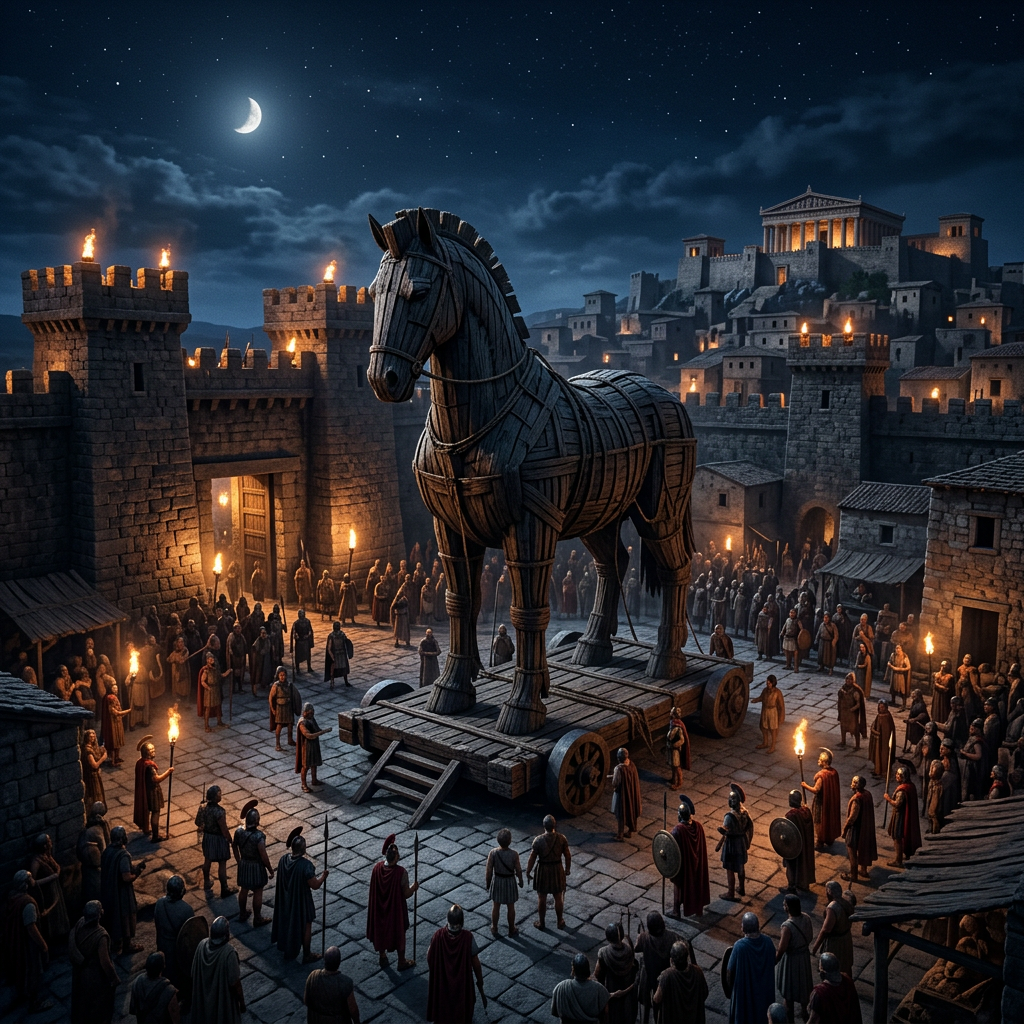
🐴 Why Troy? Because its Trojan Horse felt familiar
The Trojan Horse is one of the oldest metaphors in human history— a symbol of how the things we welcome can undo us in ways we never expect.
And I realized I had my own Trojan Horses.
People who arrived quietly, without purpose or benefit, yet changed me.
Ideas that entered softly, yet rearranged my inner architecture.
Troy taught me that not everything valuable comes through the front gate.
🌙 Why Troy? Because myth explains what logic cannot
The modern world is loud with data, logic, and efficiency. But the things that truly move us— desire, fear, pride, longing, connection— are ancient forces.
Myth explains them better than any modern theory.
Troy explains why people fight for illusions. Troy explains why desire reshapes history. Troy explains why systems collapse from the inside. Troy explains why the strongest walls fall to the softest stories.
And maybe that’s why I turned toward Troy. Because myth speaks the language of the human heart in a way modern life has forgotten.
🌌 And so, Hun’s Mythology began
Not because I wanted to study ancient battles, but because Troy whispered something familiar.
Its chaos looked like mine. Its gods looked like my systems. Its walls looked like my defenses. Its Trojan Horse looked like my relationships. Its fall looked like my transformations.
Troy wasn’t a story I discovered. It was a story that recognized me.
And from that recognition, Hun’s Mythology began— a way of seeing the world where ancient patterns echo through modern life, and where my own inner landscape is just another chapter in a story as old as humanity.
🌒 Epilogue — This Is As Far As My Myth Goes
When you walk through myth long enough, you begin to see paths that descend endlessly. Linguistics branches off, classics sink deeper, religion and anthropology intertwine, philosophy and sociology stack themselves like ancient stones.
Experts devote their lives to those depths. Scholars chase the bottom of that well. Their world has no end, and searching for that end becomes their purpose.
But I don’t need to walk that far. No one is waiting to hand me a degree, no one is asking me for a dissertation. I turned to myth for one reason only— to understand my own life.
And now, I’ve absorbed exactly as much myth as I can hold beautifully, honestly, and in my own way.
The chaos of Troy was a mirror for the chaos in my life.
The gods of Troy were reflections of the systems I live under.
The walls of Troy resembled the firewalls I built around myself.
The Trojan Horses looked like the quiet relationships that changed me.
The fall of Troy echoed the transformations I’ve lived through.
I didn’t study myth. I used myth to read myself.
And that is enough. In truth, that is the most human kind of learning.
So I stop here. Any deeper, and it becomes someone else’s discipline, not my story.
I’ve taken the part of myth I understand, shaped it in my own language, interpreted it with my own senses, and connected it to my own life.
Hun’s Mythology is complete as it is.
Now I close the book of myth. But the story will keep living inside me— like the glow of Troy’s fire, like the rhythm of a city at night, like the expressions of people passing by, like the small movements of my own heart.
Myth never disappears. It simply continues under different names within the life I live.
And perhaps that name will be remembered like this:
Hun’s Mythology.
🌌 Hun’s Mythology — 왜 트로이가 나를 불렀는가
신화는 사라지지 않는다. 그저 이름을 바꾸고, 옷을 갈아입고, 다른 신전을 찾을 뿐이다. 그리고 트로이의 폐허와 현대 도시의 네온 사이 어딘가에서 나는 내가 이미 하나의 신화 속에서 살아왔다는 사실을 깨달았다.
하지만 그 모든 깨달음 이전에, 아주 조용하고 우연한 순간이 있었다. 트로이 전쟁이 나를 끌어당기기 시작한 순간.
나는 고대 전쟁에 특별한 관심이 있었던 것도 아니고, 신화학을 공부한 것도 아니고, 신들의 세계를 탐구하려 했던 것도 아니다.
그런데 어느 날, 트로이 이야기가 이상하게도 익숙하게 느껴졌다. 마치 내가 이미 그 이야기의 일부를 살아온 것처럼.
🏺 왜 트로이인가? 그 혼란이 내 삶과 닮아 있었기 때문이다
트로이 전쟁은 단순한 이야기가 아니다. 욕망, 자존심, 정치, 운명, 신들의 장난이 뒤엉켜 폭발하는 복합적 혼돈이다.
그리고 그 혼돈이 묘하게 현대의 삶과 닮아 있었다.
수많은 힘이 서로 다른 방향으로 끌어당기고, 그 힘들은 눈에 보이지 않지만 분명히 우리를 움직인다.
트로이는 단순한 신화가 아니라 내 삶의 거울이었다.
사람들이 왜 이해할 수 없는 것들을 위해 싸우는지, 욕망이 어떻게 역사를 바꾸는지, 권력이 어떻게 아름다운 이야기 뒤에 숨어 있는지.
나는 트로이를 공부한 것이 아니라 트로이를 인식한 것이었다.
🔮 왜 트로이인가? 그 신들이 내가 사는 시스템과 닮아 있었기 때문이다
트로이 신화 속 신들은 감정적이고, 정치적이고, 예측 불가능하다. 그들은 인간의 삶에 개입하고, 조종하고, 축복하고, 벌한다.
그리고 나는 어느 순간 그 신들을 현대에서 다시 보았다.
아폴론은 전문가와 알고리즘이 되었고, 제우스는 국가와 제도가 되었고, 아테나는 기술과 혁신이 되었고, 아프로디테는 소비 욕망이 되었고, 아레스는 시장 경쟁이 되었다.
신들은 죽지 않았다. 그저 현대 건물 속으로 이사했을 뿐이다.
트로이는 그 사실을 보게 해주었다.
🌫️ 왜 트로이인가? 그 성벽이 내 방화벽과 닮아 있었기 때문이다
트로이의 성벽은 전설적이었다. 두껍고, 자존심으로 가득하고, 절대 무너지지 않을 것처럼 보였다.
하지만 그 성벽은 힘으로 무너진 것이 아니라 ‘선물’로 위장한 이야기 하나에 무너졌다.
나에게도 성벽이 있었다. 효율성과 자기 보호, 현대적 신화로 만든 나만의 심리적 방화벽.
트로이는 나에게 물었다. 나는 무엇을 막고 있었는가? 그리고 무엇이 이미 들어와 있었는가?
🐴 왜 트로이인가? 그 트로이 목마가 내 삶에도 있었기 때문이다
트로이 목마는 인류 역사에서 가장 오래된 은유다. 겉으로는 선물처럼 보이지만 실제로는 내부를 무너뜨리는 침투 장치.
그리고 나는 깨달았다. 내 삶에도 트로이 목마들이 있었다.
겉으로는 “그냥 편한 사람”, “그냥 스쳐 지나가는 인연”, “그냥 가벼운 대화”처럼 보였지만,
그들은 내 방화벽을 조용히 통과해 내 마음을 흔들고, 내 생각을 바꾸고, 내 세계를 넓혀주었다.
효율성으로 설명되지 않는 관계. 이득으로 계산되지 않는 연결. 세속적 신화로 정의되지 않는 감정.
그것이 바로 나의 트로이 목마였다.
🌙 왜 트로이인가? 신화는 논리로 설명되지 않는 것을 설명하기 때문이다
현대 세계는 데이터와 논리, 효율로 가득하다. 하지만 인간을 움직이는 진짜 힘— 욕망, 두려움, 자존심, 갈망, 관계— 이 모든 것은 고대적이다.
신화는 그 힘들을 현대 이론보다 훨씬 정확하게 설명한다.
트로이는 사람들이 왜 환상을 위해 싸우는지, 욕망이 어떻게 역사를 바꾸는지, 시스템이 왜 내부에서 무너지는지, 가장 강한 성벽이 왜 가장 부드러운 이야기 하나에 무너지는지 모두 설명해준다.
그래서 나는 트로이로 향했다. 신화는 인간의 마음이 잊어버린 언어를 말해주기 때문이다.
🌌 그리고 그렇게 Hun’s Mythology가 시작되었다
나는 고대 전쟁을 공부하려 한 것이 아니다. 트로이가 나에게 말을 걸었기 때문이다.
그 혼란이 내 삶과 닮아 있었고, 그 신들이 내가 사는 시스템과 닮아 있었고, 그 성벽이 내 방화벽과 닮아 있었고, 그 트로이 목마가 내 관계와 닮아 있었고, 그 몰락이 내 변화와 닮아 있었다.
트로이는 내가 발견한 이야기가 아니라 나를 알아본 이야기였다.
그 인식에서 Hun’s Mythology가 시작되었다. 고대의 패턴이 현대의 삶을 울리고, 내 내면의 풍경이 인류의 오래된 서사의 한 장면이 되는 방식.
이것이 내가 이해한 신화의 본질이다.
🌒 Epilogue — 여기까지가 나의 신화다
신화를 따라 걷다 보면 끝없이 깊어지는 길들이 있다. 언어학으로 빠지고, 고전학으로 내려가고, 종교학과 인류학이 서로 얽히고, 철학과 사회학이 그 위에 겹겹이 쌓인다.
전문가들은 그 길을 평생 걷는다. 학자들은 그 깊이를 끝까지 파고든다. 그들의 세계는 끝이 없고, 그 끝을 찾는 것이 그들의 삶이다.
하지만 나는 그 길을 끝까지 갈 필요가 없다. 누가 나에게 학위를 줄 것도 아니고, 누가 나에게 논문을 요구하는 것도 아니다. 나는 그저 내 삶을 이해하기 위해 신화를 불렀을 뿐이다.
그리고 지금, 나는 내가 이해할 수 있는 만큼의 신화를 충분히, 아름답게, 나답게 흡수했다.
트로이의 혼란은 내 삶의 혼란을 비춰주는 거울이었고,
트로이의 신들은 내가 살아가는 현대 시스템의 얼굴이었고,
트로이의 성벽은 내가 쌓아온 방화벽과 닮아 있었고,
트로이 목마는 내 삶에 조용히 들어와 나를 바꾼 인연들이었고,
트로이의 몰락은 내가 지나온 변화의 순간들과 겹쳐 있었다.
나는 신화를 연구한 것이 아니라 신화를 통해 나를 읽었다.
그것이면 충분하다. 아니, 그것이야말로 가장 인간적인 공부다.
그래서 나는 여기서 멈춘다. 더 깊이 들어가면 그건 나의 서사가 아니라 남의 학문이 된다.
나는 내가 이해한 만큼의 신화를 내 언어로 정리했고, 내 감각으로 해석했고, 내 삶과 연결했다.
Hun’s Mythology는 그 자체로 완성이다.
이제 나는 신화를 덮는다. 하지만 그 이야기는 내 안에서 계속 살아 있을 것이다.
트로이의 불빛처럼, 도시의 리듬처럼, 사람들의 표정처럼, 내 마음의 작은 움직임처럼.
신화는 사라지지 않는다. 그저 나의 삶 속에서 다른 이름으로 계속 살아갈 뿐이다.
그리고 그 이름은 아마도 이렇게 불릴 것이다.
Hun’s Mythology.
