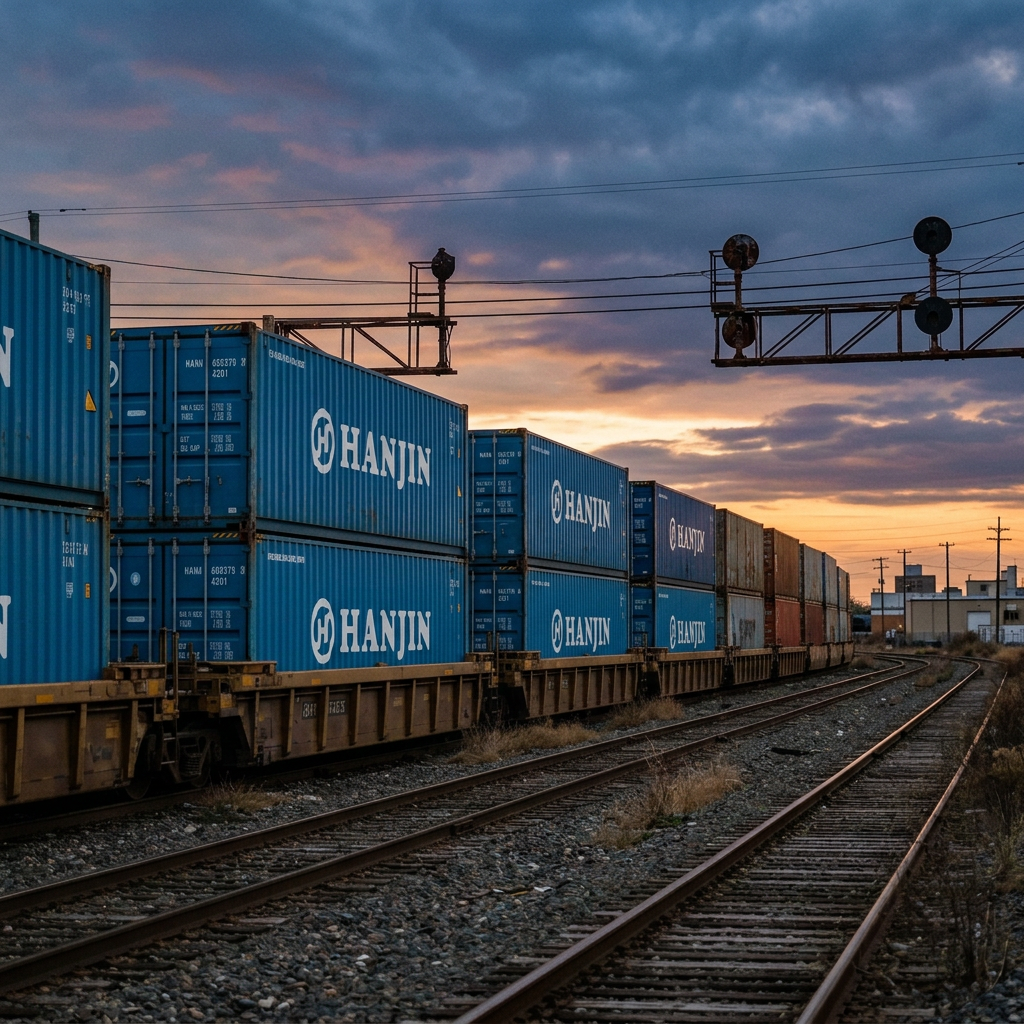
I still live in the United States. And living here, there are moments when I unexpectedly feel connected to Korea. One of those moments comes from watching freight trains.
American freight trains are unbelievably long—sometimes stretching farther than the eye can see. And for years, the cars on those trains were stacked two or three high with blue containers marked HANJIN in white letters.
Dozens, sometimes hundreds of them. Seeing those containers felt like watching Korea move across the American landscape. It was a quiet reminder that Korean goods were flowing through the U.S. economy every single day.
It gave me a small sense of pride. “Korea is really part of the world.” “Korean logistics is strong enough to be everywhere.”
But then, one day, those containers disappeared. Not gradually—just gone.
In their place were COSCO, China Shipping, OOCL, CMA CGM, and other foreign carriers stacked high on the same freight trains.
I paused.
“Where did Hanjin go?” “Why aren’t Korean containers here anymore?” “What happened to Korean shipping?”
That simple moment—on an ordinary day, watching an ordinary train— was the beginning of my search.
1. A Period of Policy Vacuums — When the Administrative System Lost Focus
Hanjin’s collapse didn’t happen in isolation. It unfolded during a period when the Korean government was losing its ability to focus on long-term industrial strategy.
From 2014 to 2016:
- The Sewol ferry disaster exposed failures in national crisis response.
- The MERS outbreak revealed weaknesses in public health administration.
- The political scandal surrounding the presidency disrupted decision-making at the highest level.
The government’s attention was scattered. Strategic industries—like shipping—were not receiving the focus they needed. This wasn’t a sudden failure; it was a structural weakening of the administrative system.
2. Distorted Information Flow — Reports Were Written, but Not Delivered
When a government loses focus, the first thing that breaks is the flow of information.
Normally, policy moves through a clear path:
Ministry → Blue House → President.
But during this period, that path narrowed.
In reality:
- Ministries prepared reports.
- Some reports were filtered or delayed.
- Complex industrial issues were pushed down the priority list.
This wasn’t about one person’s capability. It was about an administrative structure that had become unusually narrow and fragile.
3. The Gatekeepers — When Three Aides Controlled the President’s Door
The so‑called “three gatekeepers” controlled the president’s schedule, documents, briefings, and meetings. Over time, their role shifted from managing information to selecting and blocking it.
They read the president’s preferences and acted accordingly. And in Korean political culture, subordinates often adjust themselves to the leader’s interests.
At that time, the president’s attention leaned heavily toward symbolic diplomatic events— speeches abroad, international visits, and image-driven engagements.
So:
- Diplomatic events were prioritized.
- Industrial restructuring reports were pushed aside.
- Shipping and shipbuilding issues received less direct attention.
The president may never have fully grasped the scale of the crisis.
4. What Ministries Actually Reported — A National-Level Warning
The ministries did not ignore the problem. They saw the crisis clearly and raised alarms.
Ministry of Trade, Industry and Energy
- Global freight rates collapsing
- Oversupply of ships
- Alliance restructuring
- Hanjin’s liquidity crisis
- Urgent need for restructuring
Ministry of Oceans and Fisheries
- National export logistics at risk
- Containers facing seizure at ports
- Korea being pushed out of global alliances
- Potential nationwide logistics paralysis
Financial institutions
- High probability of bankruptcy without support
- Need for clear government direction
But these warnings may not have reached the president in full.
5. After Hanjin Collapsed — Korea Became Dependent on Foreign Shipping
Hanjin was Korea’s largest carrier and the world’s seventh largest. Its collapse was not just a corporate failure—it was a national logistics failure.
✔ Korea lost 62% of its container capacity overnight.
More than half of the nation’s shipping capability vanished.
✔ Foreign carriers took over Korean routes.
Maersk, MSC, CMA CGM, and Chinese carriers absorbed Hanjin’s networks.
✔ Busan’s transshipment volume dropped sharply.
Korea began losing its position as a logistics hub in Asia.
✔ Korean exporters became dependent on foreign carriers.
Shipping costs rose. Stability declined.
✔ Korea, the world’s top shipbuilding nation, suddenly had no major national carrier.
A strange and painful contradiction.
6. Late Government Intervention — Rebuilding What Was Lost
About 18 months after the collapse, Korea finally began rebuilding its shipping sector.
- KSP: A cooperation network among Korean carriers
- KOBC: A national shipping finance institution
- Five-year rebuilding plan
- Mega-ship orders for HMM
Korea regained some ground, but the global network Hanjin built over decades was not fully restored.
7. Why Korea Never Discussed This Structural Failure
Despite the scale of the collapse, Korean society rarely talks about it.
Why?
- A culture that focuses on individual blame, not structural causes
- Political sensitivities around criticizing the administration of that era
- Shipping and logistics being invisible to the general public
- Media lacking expertise in industrial structure
- A political environment that avoids admitting policy failures
- A national tendency to overlook shipping as a strategic asset
All of this created silence around a major national failure.
🌊 Conclusion — The Missing Containers That Asked a Question
Even today, I see freight trains in the United States. They still carry containers stacked two or three high. But none of them say HANJIN anymore.
That absence asked me a question:
“What happened to Korean shipping?”
Following that question led me to understand that Hanjin’s collapse was not just a corporate bankruptcy. It was the fall of a national infrastructure. And it pushed Korea into a structure where foreign carriers control much of its logistics lifeline.
I’m not writing this to blame anyone. I’m writing because this structural truth was never fully discussed. And sometimes, the quiet disappearance of a container on a freight train can reveal more about a country than any headline.
🌊 사라진 컨테이너에서 시작된 질문 — 내가 한진 파산을 다시 공부하게 된 이유
나는 지금도 미국에서 살고 있다. 여기서 살다 보면, 일상 속에서 한국을 느끼는 순간들이 있다. 그중 하나가 화물열차다.
미국의 끝이 보이지 않는 상업용 화물열차가 지나갈 때면 그 위에는 늘 푸른색 바탕에 흰 글씨로 적힌 HANJIN 컨테이너가 이중, 삼중으로 쌓여 있었다. 수십 개, 수백 개가 연결된 그 열차는 한국에서 출발한 물건들이 미국 전역으로 퍼져나가는 거대한 물류의 흐름을 그대로 보여주는 장면이었다.
그 풍경은 내게 늘 자부심 같은 감정을 줬다. “한국이 세계와 이렇게 연결되어 있구나.” “한국 물류가 미국 경제의 한 축을 담당하고 있구나.”
그런데 어느 날부터 그 컨테이너가 통째로 사라졌다. 아예 보이지 않았다. 대신 COSCO, China Shipping, OOCL, CMA CGM 같은 중국과 유럽 선사들의 컨테이너가 열차 위를 가득 채우고 있었다.
그 순간 나는 멈칫했다.
“한진은 어디로 갔지?” “왜 한국 컨테이너가 사라졌지?” “한국 해운에 무슨 일이 있었던 거지?”
그 단순한 의문이 내가 한진 파산을 다시 공부하게 된 출발점이었다.
1. 정책 공백의 시대 — 행정 구조가 흔들리다
한진이 흔들리기 시작한 시기(2014~2016)는 박근혜 정부가 여러 사건으로 국정 운영의 집중력을 잃어가던 시기와 정확히 겹친다.
- 세월호는 국가 위기 대응 체계의 붕괴를 드러냈고
- 메르스는 보건·행정 시스템의 취약성을 노출했으며
- 국정농단은 정책 결정 구조 자체를 마비시켰다
이 시기 정부는 장기적·전략적 산업 구조조정에 집중할 여력을 잃었다. 정책 공백은 갑자기 생긴 것이 아니라 행정 구조가 흔들린 결과였다.
2. 정보 전달 경로의 왜곡 — 보고는 올라갔지만 도달하지 않았다
정책 공백이 생기면 가장 먼저 흔들리는 것이 정보 전달 경로다. 정책은 부처 → 청와대 → 대통령으로 이어지는 흐름 속에서 만들어지는데 그 흐름이 좁아지면 대통령이 접하는 정보의 폭이 줄어든다.
당시 실제로:
- 부처 보고가 대통령에게 직접 전달되지 않았고
- 일부 보고는 중간에서 걸러졌으며
- 복잡한 산업 보고는 우선순위에서 밀렸다
이건 박근혜 개인의 문제가 아니라 행정 구조가 비정상적으로 좁아진 시대적 문제였다.
3. 문고리 3인방 — 대통령에게 들어가는 ‘문’을 통제하다
문고리 3인방은 대통령의 일정·문서·보고·면담을 물리적으로 관리했다. 그 역할은 시간이 지나면서 “관리”가 아니라 ‘선별’과 ‘차단’으로 변했다.
그들은 대통령의 관심사와 취향을 읽고 움직였다. 한국 정치 행정의 오래된 관례는 “아랫사람은 윗사람의 취향을 읽고 보조한다”는 것이다.
당시 대통령은 미국 의회 연설, 중국 대학에서의 중국어 연설 등 상징적 외교 이벤트에 더 많은 관심을 보였다. 그 결과 외교 이벤트는 최우선으로 올라갔고 복잡한 산업 구조조정 보고는 자연스럽게 뒤로 밀렸다.
대통령은 한진 사태의 전체 구조를 충분히 인지할 기회를 갖지 못했을 가능성이 있다.
4. 한진 파산 당시 실제 보고 — 국가적 위기였지만…
산업부·해수부·금융권은 모두 한진 사태를 국가적 위기로 판단해 여러 차례 보고했다.
산업부
- 글로벌 운임 폭락
- 선복 과잉
- 얼라이언스 재편
- 한진 유동성 위기
- 구조조정 시급
해수부
- 한진 파산 시 한국 수출 물류 마비
- 항만 컨테이너 압류 위험
- 글로벌 얼라이언스에서 한국 배제
- 물류 대란 가능성
금융권
- 지원 중단 시 파산 가능성 매우 높음
- 정부의 명확한 정책 신호 필요
그러나 이 보고들이 대통령에게 직접 도달하지 못했을 가능성이 높았다.
5. 한진 파산 이후 — 한국 해운은 외국 의존 구조로 바뀌었다
한진은 한국 1위, 세계 7위 해운사였다. 그 파산은 단순한 기업 파산이 아니라 국가 물류 주권의 붕괴였다.
✔ 한국 선복량 62% 증발
한국 전체 컨테이너 운송 능력의 절반 이상이 사라졌다.
✔ 한국 항로가 외국 선사에게 넘어감
Maersk·MSC·CMA CGM이 한진의 항로를 그대로 가져갔다.
✔ 부산항 환적 물량 급락
한국은 아시아 물류 허브 지위를 잃기 시작했다.
✔ 한국 수출기업은 외국 해운사에 의존
운임 상승, 물류 불안정이 이어졌다.
✔ 한국은 세계 최고 조선국가인데
그 배를 운용할 자국 해운사가 없는 모순적 상황이 되었다.
6. 뒤늦은 국가 개입 — 해운 재건의 시작
한진 파산 이후 18개월 동안 한국 정부는 처음으로 해운을 국가 인프라로 규정하고 재건 작업을 시작했다.
- KSP: 국내 해운사 협력체
- KOBC: 국가 해운 금융기관
- 5개년 해운 재건 계획
- HMM 초대형 선박 확보
한국 해운은 부분적으로 회복했지만 한진이 수십 년간 구축해온 글로벌 네트워크 전체를 되찾은 것은 아니다.
7. 왜 한국은 이 구조적 실패를 논의하지 않았는가
한국 사회는 전통적으로 “누가 잘못했냐”만 묻고 “왜 이런 구조가 생겼냐”는 잘 묻지 않는다.
- 개인 책임만 묻는 문화
- 박근혜 비판이 정체성 공격처럼 느껴지는 분위기
- 해운·조선·물류가 국민에게 보이지 않는 산업
- 언론의 구조 분석 능력 부족
- 정책 실패를 인정하지 않는 정치 문화
- 해운을 국가 안보로 보지 않는 시각
이 모든 것이 겹쳐 한국 사회는 한진 파산을 정치적·산업적·국가적 실패로 분석하지 못했다.
🌊 결론 — 사라진 컨테이너가 던진 질문
지금도 미국에서 나는 화물열차를 본다. 그 위에는 여전히 수십 개의 컨테이너가 이중·삼중으로 쌓여 있다. 하지만 그 위에 HANJIN이라는 글씨는 더 이상 없다.
그 사라진 컨테이너는 나에게 하나의 질문을 던졌다.
“한국 해운은 왜 이렇게 되었을까?”
그 질문을 따라가다 보니 한진 파산은 단순한 기업 파산이 아니라 국가 기간산업이 무너진 사건이었다는 사실을 알게 되었다.
그리고 그 구조적 실패는 한국 해운을 외국 의존 구조로 바꾸어 놓았다.
나는 이 글을 누구를 비난하기 위해 쓰는 것이 아니다. 한국 사회가 말하지 못한 구조적 진실을 조용히, 담담하게, 중용의 시선으로 기록하기 위해 쓰는 것이다.
